

25 October 2014. Today is my mother’s birthday. She is ninety-six years old.
Last year, we held a small celebration in the nursing home dining room. In her ward, there are only a handful of residents, all of whom are too old or too frail to care for themselves. My daughter, my eldest son, and I were the only visitors. We brought a chocolate cake and a few cupcakes, and tied balloons to the chairs to add a festive touch.
The residents were not impressed by these strangers invading their territory. One indignant old lady announced, without negotiation, that she was afraid of balloons; they were to be removed immediately. Old age does not always soften people; sometimes it sharpens them, especially when routine is disturbed. Still, everyone enjoyed the cake.
We placed a plastic princess crown on my mother’s head. She was delighted. Even more so by the photo collage we made for her: herself as a child, as a young woman, on her wedding day, and later in her middle years. She studied it with interest, though she didn’t quite understand that this day was her birthday. She kept asking how old she was.
This year, I chose to keep the celebration quiet, and we are eating birthday cake in her room.
My mother now has a new roommate, and the two of them seem content together. They talk all day and eat side by side in the dining room. My mother enjoys our visit, the cake we bring and the attention, but the reason for it all escapes her. This year, she does not even ask how old she is.
I sit beside her bed and stare at the strangely small, emaciated body propped up by pillows. Wrinkled skin. Crooked fingers. And then, uninvited, memory overlays the present: the strong, beautiful woman she once was, the many facets of her personality I never fully understood and never truly got to know.
Until about a year ago, there were moments when her memories broke through the fog. She would talk about her childhood, always the same stories, often with twisted facts and drifting logic. Now she speaks very little. Mostly she sits quietly, staring at nothing in particular, eyes still a vivid, startling blue.
Several people commented today that she has reached a blessed age.
I do not respond. How does one answer such a hollow phrase? What is blessed about a life that has already ended in every way that matters, remembered only by others, and sometimes not even that? What is blessed about a body that persists while the person has slowly slipped away? Or is this sustained life supposed to be a blessing to those who watch, helpless, as physical and spiritual decline stretch on, long after the life itself has quietly departed?
All this while scrambling to keep up with the relentless costs of care: the nursing home fees, special foods, adult diapers, and the steady stream of doctors’ bills. My mother has no medical aid and no income beyond a minimal government pension.
My greatest fear during the years that I cared for her was simple and brutal: that at some point I would no longer be able to care for her, and that there would be nowhere else for her to go. Nobody else would be willing to look after her. Two parents seemed to cope quite well bringing up ten children, but caring for one mother seems to be an impossible task for ten children.
By then, I was the sole breadwinner in my family, and I retired the year before. Two bouts of cancer had left my health fragile, and my working environment had become unbearable; ongoing restructuring, endless office politics, and workdays that refused to end even after I arrived home, still chasing unfinished deadlines.
I was sixty-one years old, slowly self-deleting without really meaning to.
Eventually, unable to cope any longer, I opted for early retirement. The pension was modest, painfully so, and half of it vanished every month into medical aid contributions. But retaining my medical cover was non-negotiable; I knew my precarious physical health would not forgive recklessness.
It remains one of the few decisions in my life that I have never regretted.
What my mother does not yet know is that this birthday will be her last at this institution. I had already sold my house and was preparing to move. Arrangements were in place to transfer her to a government facility closer to my brother’s home. I needed him and his wife to take over her care while I allowed myself time to heal, physically and mentally, and to try, once more, to rebuild my family life.
Yes, I felt guilty for leaving her behind, but I also realised that she probably would not really miss me.
These days, my mother no longer really recognises me. Only when I greet her and call her “mom” does something click. She smiles, says my name, and tells me how glad she is that I came to visit. I was here yesterday. She has forgotten that. She forgets that I come every day. I am pretty sure it will not be long before she forgets me entirely.
I am her youngest child and her only surviving biological daughter. I bear her name. I look like her. Despite a mother–daughter relationship that was often stormy and uncertain, it is still difficult to accept how easily she can forget the daughter who cares for her, visits her, and manages her life on her behalf.
She sometimes remembers the man she was married to for more than fifty years, the father of her five children. “He was a handsome man,” she says, though she cannot recall their life together, or even his name. She married him at twenty-three. He was seventeen years older, a widower with six daughters between the ages of two and fifteen.
There were times when she asked me about my father and his daughters from his first marriage, though their names escaped her. She still remembers one of my brothers, her biological son, the one now taking over her care, and asks when he will visit again. I jokingly refer to him as her favourite; she laughs and does not deny it.
She has forgotten that she gave birth to two other sons. My eldest brother died fourteen years ago, colon cancer, at fifty-eight. I am grateful she no longer remembers that grief; it only distresses her.
She never speaks of her youngest son, whom she last saw at my father’s funeral in 1990, almost twenty-five years ago.
She has forgotten the baby girl who was stillborn a year and a half before I was born.
My mother has forgotten her life.
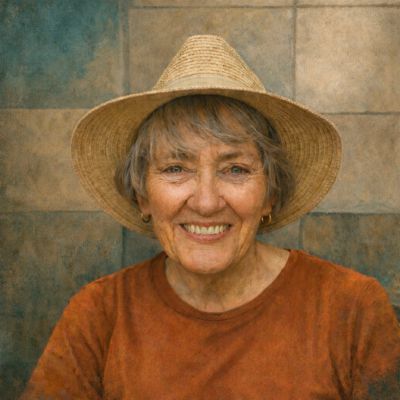
Featured image: A stylised photo of my daughter helping to celebrate her grandmother's ninety-fifth birthday.

So mooi geskryf!
Mooi geschreven ja, Hester. Er is meestal weinig ‘gezegend’ aan een hoge leeftijd bereiken.
Dit gebeur al hoe meer Anuk, want mediese bystand laat mense langer leef, maar jy kan noiit vergeet dat jou gesindheid en ‘n rede om te leef, eintlik belangriker is. Om net te bestaan, is nie genoeg – jy moet lééf en die lewe geniet na die beste van jou vermoë.
Heel raak geschreven Hester, ik ben het daar helemaal mee eens <3