



Caring for an ageing parent at home meant we had to re-establish family boundaries and learn to cope with caregiver stress. The peace in our home was already fragile when my ageing mother came to live with me. What followed was a quiet unravelling shaped by differences related to faith, distance, and long-held resentments. Sharing a home forced those differences into the open and pushed me to draw boundaries I had long avoided.
In my parents' home, our entire family of ten siblings chose to leave home as soon as we were self-sufficient. This had a lot to do with tradition during those years and with our generation appreciating how expensive it was to support a household with so many dependents. Another decisive factor was the strict religious restrictions and discipline to which we were subjected as children. This was not the case in all households, but our parents were almost fanatically religious and insisted that we also follow these biblical commandments. We passively rebelled by leaving the nest as soon as possible, because discussions about religious customs were simply not allowed in our house.
Shortly after I, the youngest and last one of the siblings still at home, accepted a job in the local branch of a commercial bank, my father retired, and my parents moved in with my eldest brother, who married later in life. My dad was already 68 at the time.
Even at the end of his life, twenty years later, my father stubbornly refused to move into a nursing facility or old-age home. When he passed away in 1990, my mother was left without a proper income. She was 17 years younger than my father, still relatively young, but too old to re-enter the labour market, as she lacked the necessary knowledge and training, in any case. She and Daniel hated each other like poison, and as long as he was around, she would never live with me. However, the moment we divorced, she moved into our home in Cape Town. It was a disaster from the start. My children were not raised in the principles of the religion and church that she had adhered to for so many years, and wanted nothing to do with her kind of discipline and restrictions on their actions. I was struggling through the aftermath of an exhausting divorce and dealing with an ex-husband who just wouldn't let go. I accepted a transfer to Bloemfontein to get away from him, and shortly thereafter, my mother moved out.
Two of my brothers took turns housing her at various times, but my oldest brother had married since my mother moved out of his home the last time, and she just couldn't get on with either of her two daughters-in-law. My half-sisters (my dad’s daughters from his first marriage) lost interest in my mother's activities after my father passed away; she was, after all, not their biological mother. She turned increasingly to her church community for support.
My eldest brother died in 2000, and my mom found accommodation with a wonderful widow who also belonged to the same church. Nettie (not her real name, but one I chose for this story) took wonderful care of my mother. I made a monthly financial contribution, and my mother contributed her old-age pension to the household. When I was diagnosed with breast cancer shortly afterwards, I was satisfied that at least my mother was well looked after. I could devote my attention to my treatment and recovery.
But of course, things never work out as well as you would like them to, and Nettie was diagnosed with leukaemia in 2007. Mom would have to move in with me, because where else could she go? The nursing homes are always overcrowded, and my mother didn't live in the same district as me for many years, so there was no chance that I would find a place for her in a care facility at such short notice.
I knew in advance that with Daniel back under my roof, my mother would be unhappy with our lifestyle. We did not belong to a church, and we did not follow the kind of diet she was used to. My mother was convinced that she suffered from irritable bowel syndrome (IBS) and had to follow a special diet. At the time, I honestly believed most of her health and dietary problems were just in her imagination. She never showed these symptoms until my brother was diagnosed with colon cancer, which led to his death. I was proved correct in the end, but for a long while there, the imagined illness made our lives difficult.
According to her diet, she could only eat green apples that were cooked (they occasionally exploded in the microwave because they were not peeled or sliced). In the mornings, she made herself oatmeal porridge that either boiled over on the stove or in the microwave. At least she could also eat a chicken drumstick with boiled vegetables for lunch, but she wanted the chicken skinned and the veggies boiled without salt or spices. Not only did she follow a special diet, but she also used all sorts of home remedies: raw garlic and parsley on a slice of bread, ginger, turmeric, flaxseed tea (boiled in a pot on the stove), and Blackstrap molasses as a health drink. This mess upset her stomach, and she insisted on a commode in her room even though there was a fully equipped bathroom just across the passage.
Worst of all were the ointments and rinses she used for her stomachache and sore muscles: TCP, a strong-smelling antiseptic used for sore throats, mouth ulcers, and infections, which she gargled; camphor oil for her aching muscles; and eucalyptus oil to repel mosquitoes. A miasma of foul smells wafted from the kitchen and her room into the hallway.
The children and I worked full-time and were away from home all day. Daniel was in charge of the kitchen and the washing machine. He cooked and washed every day, while Emmy, the housekeeper whose salary I had to double to keep the house clean with the extra work that "grandma" caused, could not cook. Both moaned and groaned about the kitchen mess and the bad smells filling the house. My mother's laundry had to be washed separately to prevent the smell from clinging to everyone else's clothes. Daniel referred to the smell as the Egyptian Embalming Ointment (balming oils, I presume).
What drove me crazy was not that we had to cook my mother's food separately, but that she refused to eat with the family. Emmy had to serve her on a tray in her room. There was nothing wrong with her health; she could walk, but she just didn't want to eat at the table with us. I soon discovered the reason for this when Daniel came across a letter that my mother had written to her pastor explaining that she couldn't eat with us because we weren't Christians — and doesn't the Bible warn that Christians and pagans should not break bread together?
I was completely bitter about this, because I also know my Bible well and could point out that Jesus himself ate with sinners and tax collectors, but I didn't say anything. Emmy was instructed to make my mother's oatmeal porridge for her in the morning and to microwave her apples. Emmy would also not take her food to her room in the future. From now on, the Christian would have to come to the kitchen to get her food if she did not want to eat at the table.
Somewhere between duty and dignity, a boundary had to be drawn.
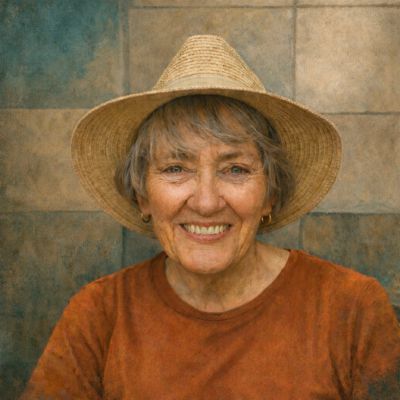
Featured image: AI-illustrated representation of an empty, unused space at the table and a chair standing to one side.


Afrikaans: https://thebraidedecho.co.za/af/2026/07/14/versorg-bejaarde-ouers-tuis/
Hester, you are a blessing. As I sit and read what a minefield your mother caused in your household, I reflect on how years later, you are the exact opposite. Living fully and sucking the marrow from each day and in a caring, loving and happy relationship with your children. Momma bear! Through your honest sharing, a cautionary tale comes to warn all of us as we grow older, not to fossilise in habits and stifling beliefs and by so doing making life unpleasant for our loved-ones and ourselves. Lots of love my brave friend.
Thank you Erna, we are both lucky to have been blessed with wonderful children.
With every new story you tell I understand more and more why you tell them. You really had the opposite of ‘an ordinary life’… What a struggle, again and again, your life has been…
Yes, there have been many potholes and obstacles in my way, and you will be reading more, not because I like to moan and groan, but because I know many other people are in the same or worse circumstances. For me it is a way of ridding myself of residual poison; for others it may be the encouragement they need (“you are not alone”). This is what I hope.